TO BECOME A HERO AT THE SÜDTIROL DOLOMITES
HERO Südtirol Dolomites
Roberto Crisi's training programmes, from 30 November 2026 to the race on 12 June 2027
Some challenges need no introduction. HERO Dolomites is the most spectacular, fascinating and exciting mountain bike marathon in the world.
Being a HERO means more than just lining up at the start in Selva Val Gardena on 12 June 2027. It means embarking on a journey of consistency, determination and passion. We are not content with seeing you at the start: we want you to arrive prepared, strong and ready to enjoy every metre of climbing, and to live a day that will stay in your sporting memory forever.
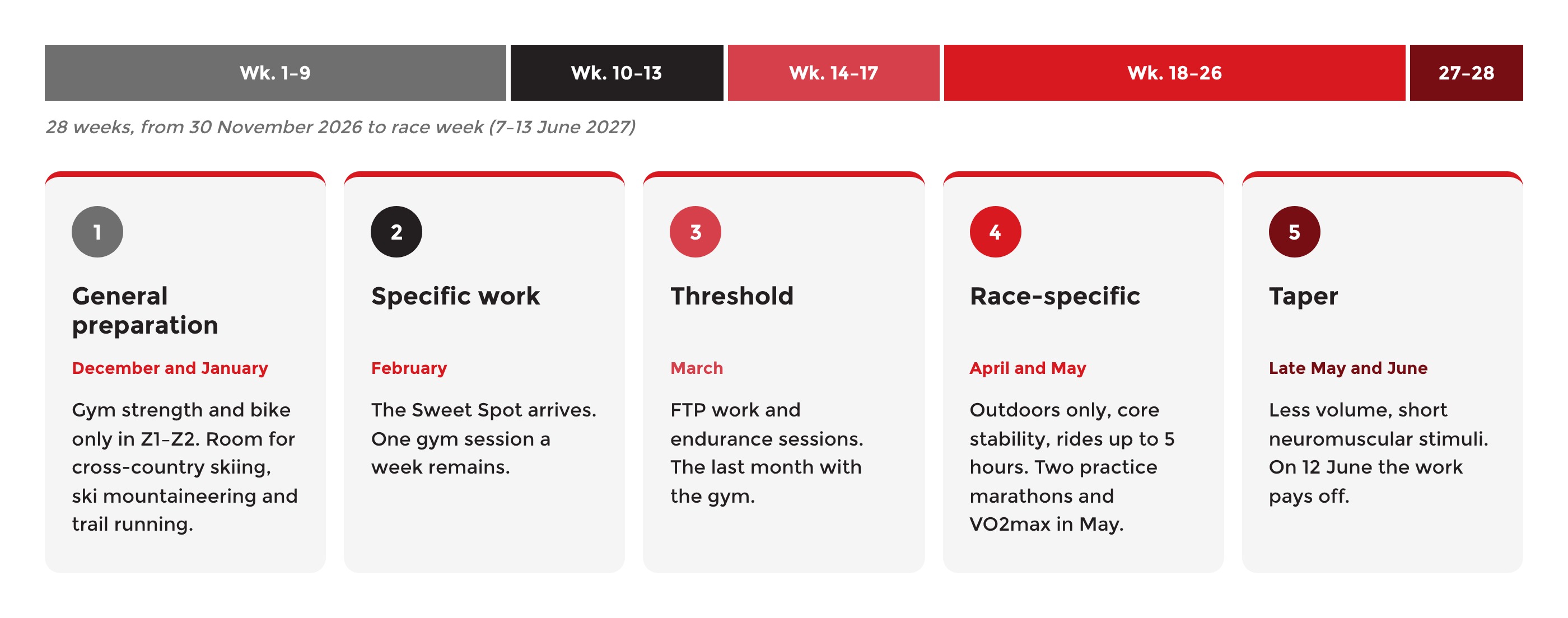
Roberto Crisi’s program designed for the HEROINES of the 60 km course (3,200 m of climbing). It runs for 28 weeks, from 30 November 2026 to race week, with particular attention to strength, energy balance and hormonal cycles, so you reach the start line strong, prepared and in control.
Choose your level:
What you need
The ideas behind the plans
Follow the plan with consistency and attention: on Saturday 12 June 2027 you will cross the finish line as a true HERO.
The programmes are general guidelines, to be adapted to your individual situation and, if needed, to your doctor's advice.
Gym strength and bike only in Z1-Z2. Room for cross-country skiing, ski mountaineering and trail running.
| Zone | Power % FTP | HR % LTHR | |
|---|---|---|---|
| Z1 | Active recovery | < 55% | Z1 < 81% |
| Z2 | Endurance | 56-75% | Z2 81-89% |
| Z3 | Tempo | 76-90% | Z3 90-93% |
| SS | Sweet Spot | 88-94% | Z3 90-93% |
| Z4 | Threshold | 91-105% | Z4 94-99% |
| Z5 | VO2max | 106-120% | Z5a-b 100-106% |
| Z6 | Anaerobic | 121-150% | Z5c > 106% |
| Z7 | Neuromuscular | > 150% | Z5c > 106% |
Gym, strength adaptation/endurance 3x10-15, RPE 6-7. Goblet squat, Romanian deadlift, step-up, hip thrust, row, push-up and core. Rest 60-90 s, no training to failure.
Aerobic endurance Z1-Z2, technique and smooth cadence, no intensity.
Zones: Power Z1-Z2 | HR Z1-Z2
1h30'Easy aerobic endurance Z1-Z2, technique and smooth cadence; no hard intervals. Cross-country skiing, ski mountaineering or easy trail running also possible.
Zones: Power Z1-Z2 | HR Z1-Z2
1h45'Easy aerobic endurance Z1-Z2, technique and smooth cadence; no hard intervals. Cross-country skiing, ski mountaineering or easy trail running also possible.
Zones: Power Z1-Z2 | HR Z1-Z2
1hLong endurance ride (MTB or road bike) or easy aerobic alternative sport, Z1-Z2: cross-country skiing, easy ski touring, snowshoeing or uphill hiking. Choose just one activity, conversational pace.
Zones: HR Z1-Z2 / easy RPE
2h15'General preparation
Target volume; adjust according to fatigue and recovery.
There are two simple ways to determine your maximum heart rate (HRmax). The first, and recommended, method is to visit a specialist sports assessment centre and undergo a maximal exercise test.
The first, and recommended, method is to visit a specialist sports assessment centre and undergo a maximal exercise test.
Please note that training programmes should only be followed after undergoing a medical assessment for competitive sport, which certifies that the individual is in good health. Health comes first!
The recommended assessment tests may be: the VO₂MAX test (maximum oxygen uptake) using a cycle ergometer, or the Conconi protocol test carried out on a bicycle:
The two protocols differ from one another (the first is preferable as, in addition to providing an indication of one’s ‘engine capacity’, it allows for the precise and reliable calculation of the ventilatory anaerobic threshold). Generally, tests of this type involve short load-increase steps (approximate duration 1’) in which resistance increases from 10W to 30W. This enables athletes to reach their maximum values more safely and quickly.
The second method involves carrying out a ‘test’ on the road:
After a good warm-up, you can tackle a climb of around 2–3 km or 10–12 minutes, gradually increasing your pace as you climb, until you reach the final 500–600 metres or approximately 1–2 minutes, which you should complete at your maximum effort.
Once you have recorded your maximum heart rate using your heart rate monitor, you can calculate your personalised training zones using the percentages shown in the KEY.
The rhythm of this training consists in: a heart rate normally produced at one’s anaerobic threshold; values equalling 90-95% of one’s own maximum heart rate; slightly laboured breathing; effort perception equals 6-7 on a 1 to 10 scale and approximately equates to the maximum intensity one could maintain with continuity uphill for no longer than 40-60 minutes. Great intensity to improve uphill anaerobic threshold, the cardiovascular system, with a good effect on VO2max improvement. This training is for inclines superior at least to 5%. Handlebar must be gripped from the top and occasionally cyclists should drive off the saddle.
This uphill training has set maximum values (not to be crossed): heart rate below 85% - 90% of anaerobic threshold heart rate (or lower than 80% - 85% of maximum heart rate). Deep, yet relaxed breaths; effort perception between 3 and 4-5 on a 1 to 10 scale. Effort intensity must be between slow and threshold levels.
Basic training rhythm, the least intense: heart rate below 75% - 80% of anaerobic threshold heart rate (or lower than 70% - 75% of maximum heart rate).; heart rate between 110 and 130 per minute; breathing is relatively normal and effort perception lies between 2-3 on a scale of 1 to 10. Intensity used to connect work between different trainings, also chosen when the chart has no specific indications (if only duration is written, exit has to be done at a slow rhythm). Every training session should start with at least 15-20 minutes at this level before moving on to other specific tools listed in the chart (e.g. fast, medium, or threshold …).
SFR is the acronym of Strength Climbs Training: the training was developed by Aldo Sassi – together with Enrico Arcelli - in 1983 to prepare Francesco Moser for the ‘Hour record’. Used to improve ‘aerobic strength’ which trains cyclist to push using high gears. It’s a series-training (one or more minutes’ climb, to then recover for 2 – 4 minutes downhill; repeat the climb, and recover once again downhill, etc.)
The following indications have to be strictly followed for optimal execution: